SaveClip

VPN vs Tor: Understanding the Real Differences in How They Protect You

Last updated: April 9, 2026

Compare VPN and Tor: how they work, their trust models, speed tradeoffs, and which tool fits different privacy needs. Not interchangeable.

NordVPN — Works in China
Imagine you need to send a letter to a journalist in a country where your government monitors mail. You have two options: hand it to a single trusted courier who promises to deliver it sealed, or give it to a chain of three messengers who each pass it along without knowing where it came from or where it's going. Both could work, but they solve the problem in fundamentally different ways. This is the core difference between a VPN and Tor.

When people ask "which one protects me better," they're usually asking the wrong question. VPNs and Tor are not interchangeable tools. They operate on different principles, trust different parties, and excel at different threats. Understanding which one fits your actual situation requires knowing how each one works, and what you're trying to protect against.

What a VPN actually does

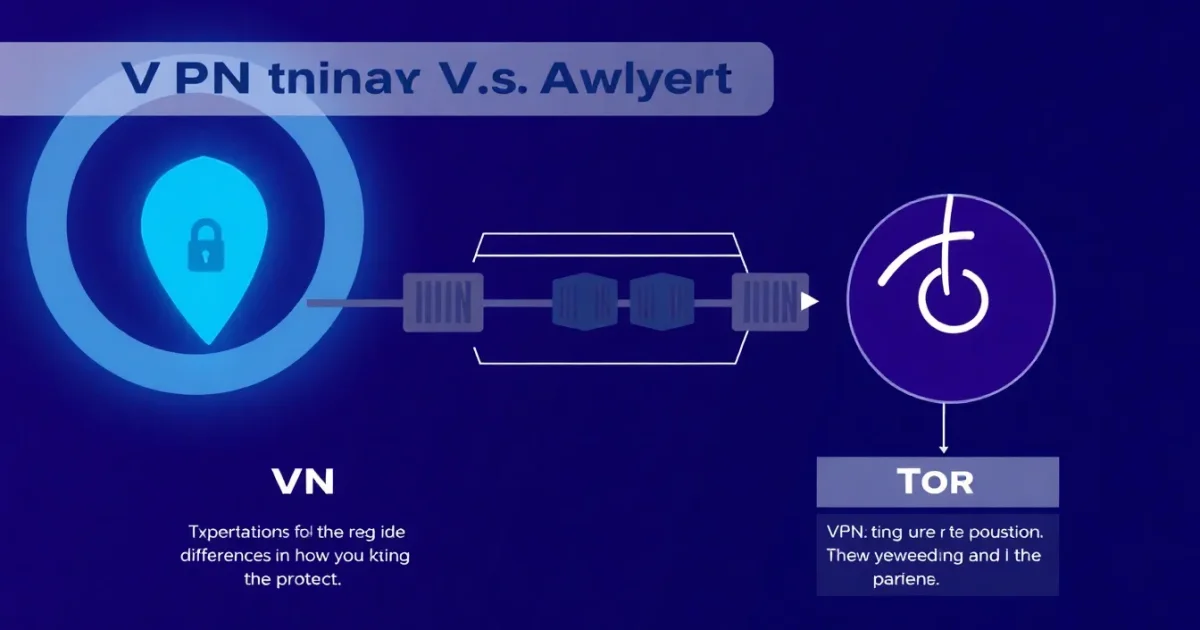
A VPN (Virtual Private Network) creates an encrypted tunnel between your device and a single server run by the VPN provider. All your internet traffic flows through that tunnel. To the websites you visit, it appears that the traffic comes from the VPN server's IP address, not yours. To your internet service provider (ISP), it looks like you're sending encrypted data to the VPN server, but they cannot see what you're doing inside that encrypted tunnel.

Think of it like using a locked mailbox on someone else's property. The mailman can see letters going into the box, but he cannot read what's inside. The person who owns the property—the VPN provider—can open that mailbox and read every letter. Your ISP knows you're using the mailbox, but not its contents.

This gives you two practical benefits: your ISP cannot see which websites you visit or what you do on them, and websites cannot easily link your real IP address to your activity. But it introduces one critical vulnerability: the VPN provider themselves can see everything. They see your traffic, and they control the exit point to the internet. If a VPN provider is compromised, keeps detailed logs, or is compelled by law enforcement to reveal what they know about you, all your traffic is exposed.

How Tor distributes trust across a network

Tor works fundamentally differently. Instead of trusting a single provider, it routes your traffic through three separate servers, called nodes or relays. Your device chooses these nodes randomly, and the nodes are run by volunteers worldwide—no single organization controls them all.

Here's the crucial part: your traffic is encrypted in layers, like Russian nesting dolls. The first node knows your IP address but cannot see where your traffic is going. The second node can see that traffic is being routed but cannot see where it came from. The third node (the exit node) can see what website you're visiting but cannot see your real IP address. No single node knows both where you came from and where you're going.

Even if someone compromised one of these nodes and read the traffic passing through it, they would only see one piece of the puzzle. An adversary would need to control or observe all three nodes simultaneously in your specific path to trace your activity back to you. This is theoretically possible but computationally expensive and difficult to do at scale.

Tor's design principle is this: trust no single party, but make breaking the system require controlling most of the network. A VPN's principle is: trust the provider, but achieve practical privacy with speed and simplicity.

Speed and practical usability

The tradeoff is immediate and real. A VPN adds minimal latency—sometimes you won't notice the difference. Tor routes your traffic through three hops, each adding delay, and the nodes are often run by volunteers on limited bandwidth. Websites load noticeably slower. Online gaming, video calls, and real-time applications become frustrating or impossible.

A VPN is also simpler to use. You install software, click a button, and everything flows through the tunnel. Tor requires either the Tor Browser (which is specific to web browsing) or Tor daemon software if you want system-wide routing, and the setup is more involved for beginners.

When each tool makes sense

Use a VPN when you want to hide your activity from your ISP or local network, and you're willing to trust a provider. This is useful if you're on public Wi-Fi and don't want people on the same network reading your passwords. It's also useful in many countries where surveillance happens at the ISP level but the government is not actively hunting you specifically.

Use Tor when you need protection against a more powerful adversary, when you cannot trust any single provider, or when you're in a situation where even a VPN provider's logs could expose you to real danger. Journalists protecting sources, activists in repressive regimes, and people facing targeted surveillance often need Tor's properties.

Tor bridges and censored networks

One more piece: in countries where Tor itself is blocked or monitored, Tor bridges exist. These are Tor relays whose addresses are not publicly listed, making it harder to detect that you're using Tor at all. Pluggable transports can also disguise Tor traffic as ordinary web traffic. These add another layer of protection against network censorship, but they do not change Tor's fundamental trust model.

What matters is understanding your actual threat

The real question is not which tool is "better." It's what you're protecting against. Are you concerned about your ISP profiling your habits? A VPN handles that. Are you worried that a government might compel your provider to give up records about you? Tor is more resilient. Are you in a place where Tor itself is detectable and dangerous? You might need bridges first, or no tool at all.

Neither tool is a magic shield. Both have limitations. A VPN cannot protect you if the site you're visiting already knows who you are. Tor cannot make you anonymous if you log into a personal account. The tool is only as effective as the situation you're using it for.

Start by understanding what you're trying to achieve, then pick the tool—or combination of tools—that actually addresses your situation. That's how informed privacy decisions get made.